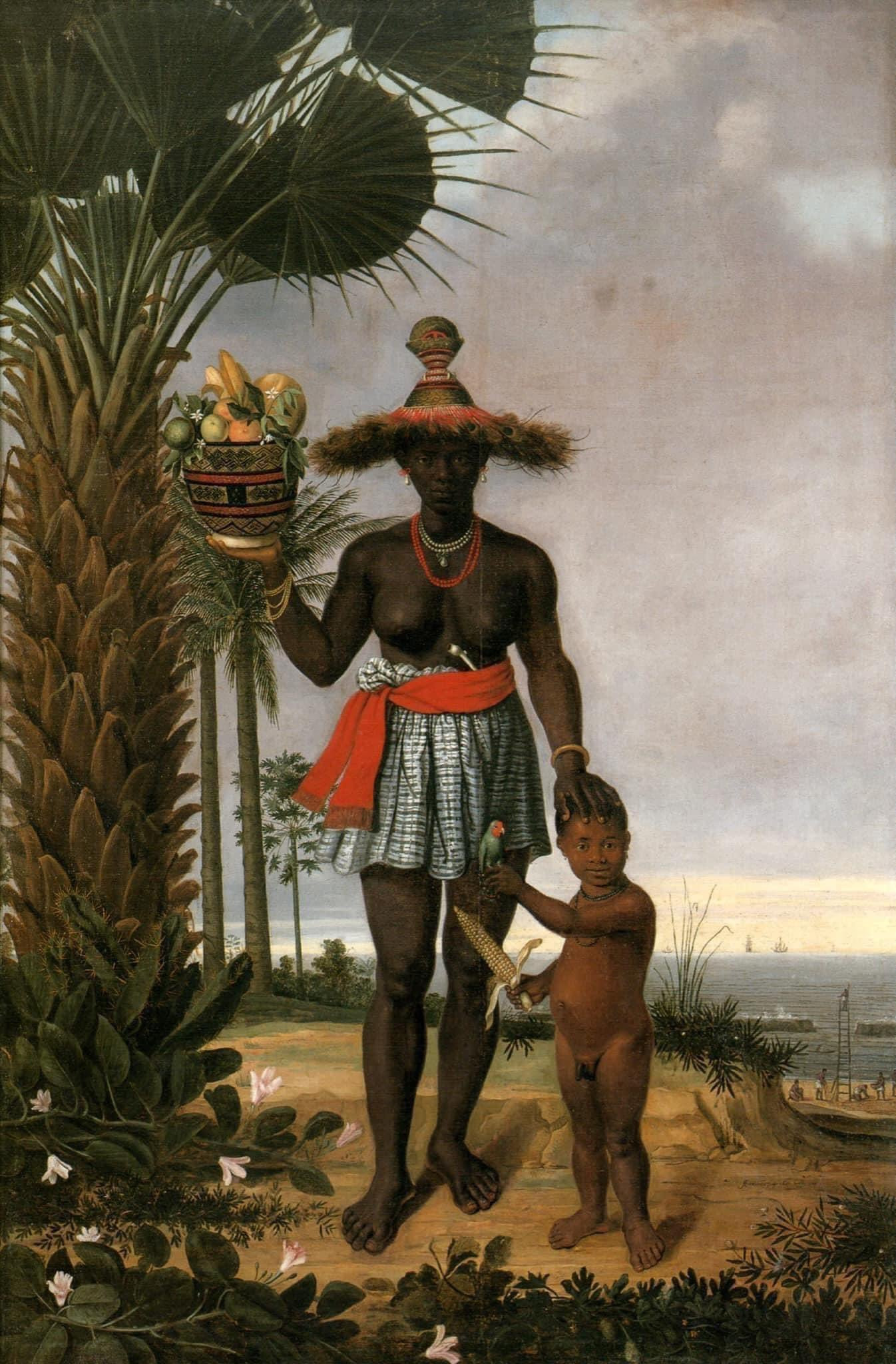
Both of these portraits were painted by Albert Eckhout in 1641. Albert Eckhout (c.1610–1665) was a Dutch portrait and still-life painter. He was among the first European artists to paint scenes from the so-called New World. He was in the entourage of the Dutch governor-general of Brazil, Johan Maurits, Prince of Nassau-Siegen, who took him to Dutch Brazil to have him record the country's landscape, inhabitants, flora and fauna. Eckhout focused on the people, plants and animals of the region when arriving in Dutch Brazil. He painted eight life-size ethnographic representations of Brazil's inhabitants. Albert Eckhout NEVER stepped foot in Africa ever in his life. The woman holds tropical Brazilian fruits. This portrait’s emphasis on fecundity and prosperity is reinforced by her cornucopia-like basket, which overflows with tropical fruit. In classical antiquity, the cornucopia, also called the horn of plenty, was a symbol of abundance and nourishment. The landscape behind her is the port of Mauritstad (today's Recife) These people are the remnants of Abu Bakar, from when he sailed to the Americas in the 1300’s.