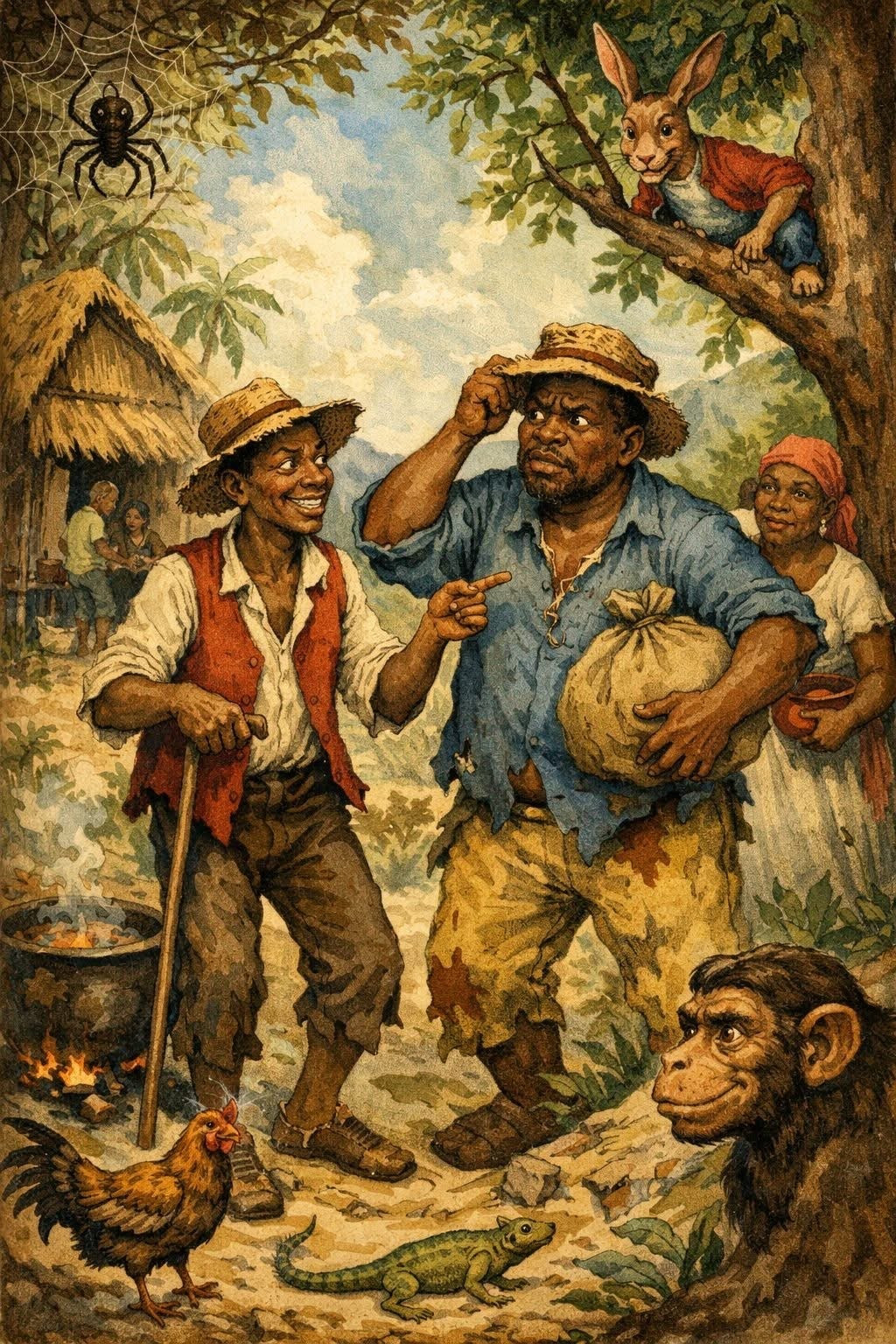
African American folklore stories include tales featuring trickster figures. These were survival stories.
Ti Malice (Haitian): A tricky figure in Haitian folklore, similar to Anansi and Brer Rabbit, who uses cleverness to outwit others.
Ti Malice is a classic trickster figure from Haitian folklore who survives through wit rather than strength. He uses clever speech, deception, and social intelligence to outmaneuver stronger or more powerful characters—most often his foil, Bouki. His stories emphasize intelligence as a tool of survival in an unjust world.
Ti Malice belongs to a broad African and African diasporic tradition of trickster figures that includes Anansi, Brer Rabbit, and the Signifying Monkey. These characters emerge from societies shaped by inequality, enslavement, and colonial rule, where direct power was denied to the oppressed. In that context, cleverness became a form of resistance.
In Haitian folklore, Ti Malice is typically small, poor, or socially marginal, yet he repeatedly triumphs over Bouki, who represents brute strength, greed, or foolish authority. The stories are humorous, but their function is serious: they teach listeners how to read power, manipulate language, and survive systems stacked against them.
Ti Malice’s tricks often rely on verbal dexterity—double meanings, false humility, and strategic lies. This connects him directly to African American oral traditions such as “signifying,” where indirect language and coded speech serve both as protection and critique. Like Brer Rabbit, Ti Malice does not overturn the system; instead, he navigates it, exposing its absurdities and exploiting its weaknesses.
Culturally, these stories served multiple purposes. They entertained, preserved African storytelling structures after the Middle Passage, and quietly transmitted lessons about survival under domination. Ti Malice is not a moral hero in the conventional sense—he can be selfish or deceptive—but he is admired because he refuses to be crushed by power.
Ti Malice represents a philosophy of survival rather than rebellion. His stories suggest that when justice is inaccessible, intelligence becomes a form of freedom. In this way, Ti Malice is less about trickery for its own sake and more about reclaiming agency in a world designed to deny it...