The Afro And The Policing Of Black Identity...
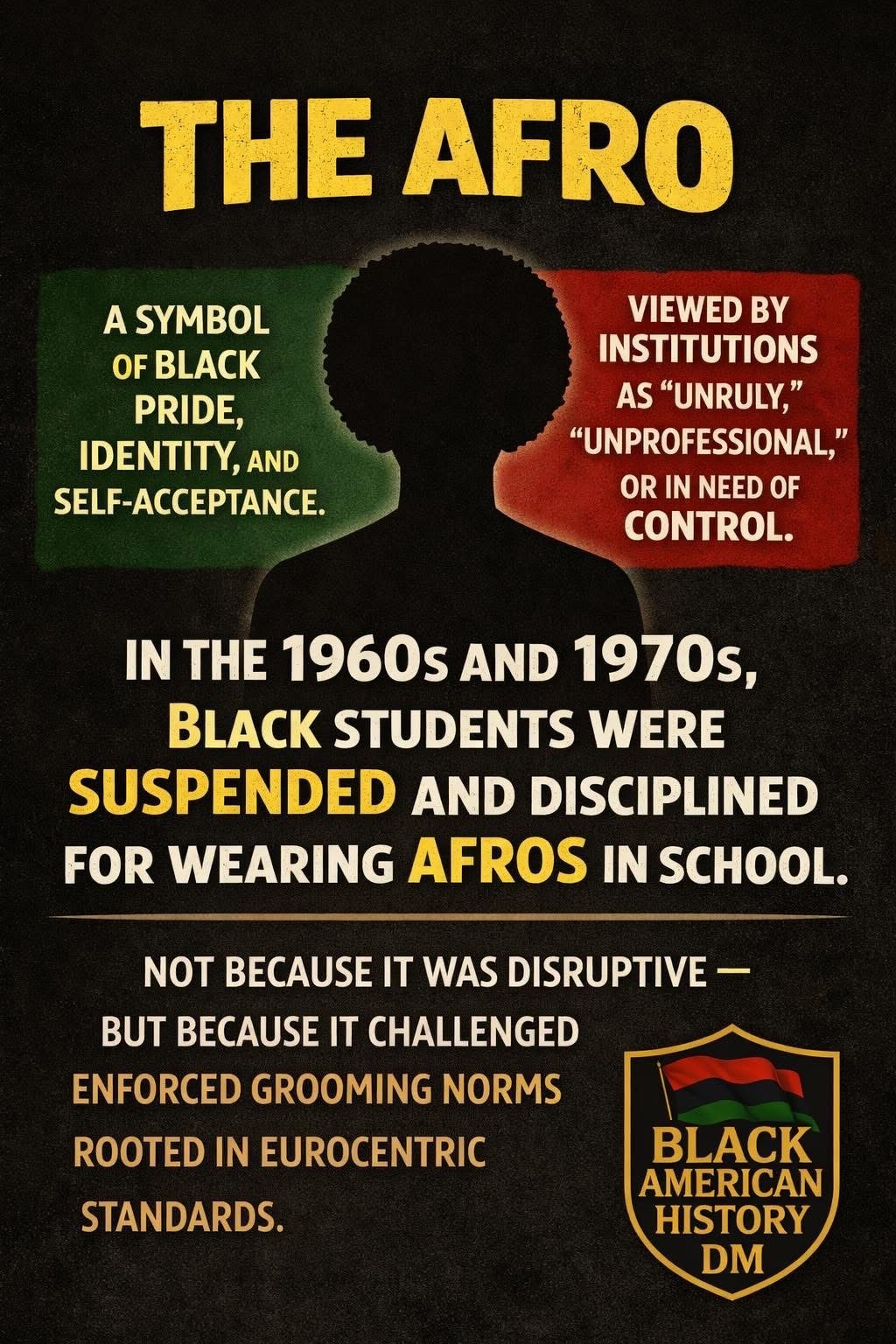
In the 1960s and 1970s, the Afro became a powerful symbol of Black pride, cultural identity, and resistance to Eurocentric beauty standards. Wearing natural hair was not a trend — it was a statement of self-acceptance and dignity in a society that had long defined “neat” and “professional” through a white cultural lens.
Because of this, Black hair was often treated as a problem by institutions. School grooming codes — written in vague terms like “distracting” or “unacceptable” — were used to discipline Black students for wearing Afros and other natural hairstyles. These policies rarely mentioned race, but they were enforced in ways that targeted Black identity.
This didn’t just happen in the past. Documented examples include:
• Tiana Parker (Oklahoma, 2013): A 7-year-old was sent home because her school banned hairstyles like Afros and locs.
• Jenesis Johnson (Florida, 2017): A teenager was told her natural Afro was “inappropriate” and had to be changed to remain enrolled.
• Darryl George (Texas, 2023–2024): A high school student was repeatedly placed in in-school suspension because his natural hairstyle (locs) was said to violate grooming rules — even after the state passed a law meant to protect natural hair.
These cases show that when institutions police Black hair, they are not just regulating appearance — they are regulating belonging. That is why laws like the CROWN Act exist: to affirm that natural Black hair is not a disruption, not a violation, and not something that needs to be corrected.
⸻
Sources (all publicly searchable)
• Institute for Democracy, Education, and Access — Hair discrimination in schools
• African American Intellectual History Society — Tiana Parker case
• Teen Vogue — Jenesis Johnson case (2017)
• Oregon Public Broadcasting / Associated Press — Darryl George case (2023–2024)
• The CROWN Act — Overview and legal purpose