History is a very fickle thing. Although it’s a constant reminder of how far we’ve come, some of our most captivating stories have been lost in the abyss of time. But this is Black folklore, the time machine of storytelling, and our mission is to uncover the stories from our past that are steeped in Black excellence. One of those tales is the story of Ben Montgomery, the former slave who purchased his master’s plantation to build a utopia for Black people escaping the harsh realities of Jim Crow. Montgomery’s story is another great testament to Black resilience. He was one of the most influential Black men in all of American history.
Benjamin Montgomery was born a slave in Loudon County, Virginia, in 1819. When he was 17, he was sent to a slave market in Natchez, Mississippi. Natchez was one of the largest domestic slave markets in the Deep South. It was known as the epicenter of American capitalism in the mid-19th century. The market operated for almost 30 years and tens of thousands of Black people were transported from Virginia, Maryland, Kentucky, and the Carolinas to the Natchez market to be sold–but all slave owners were not created equal.
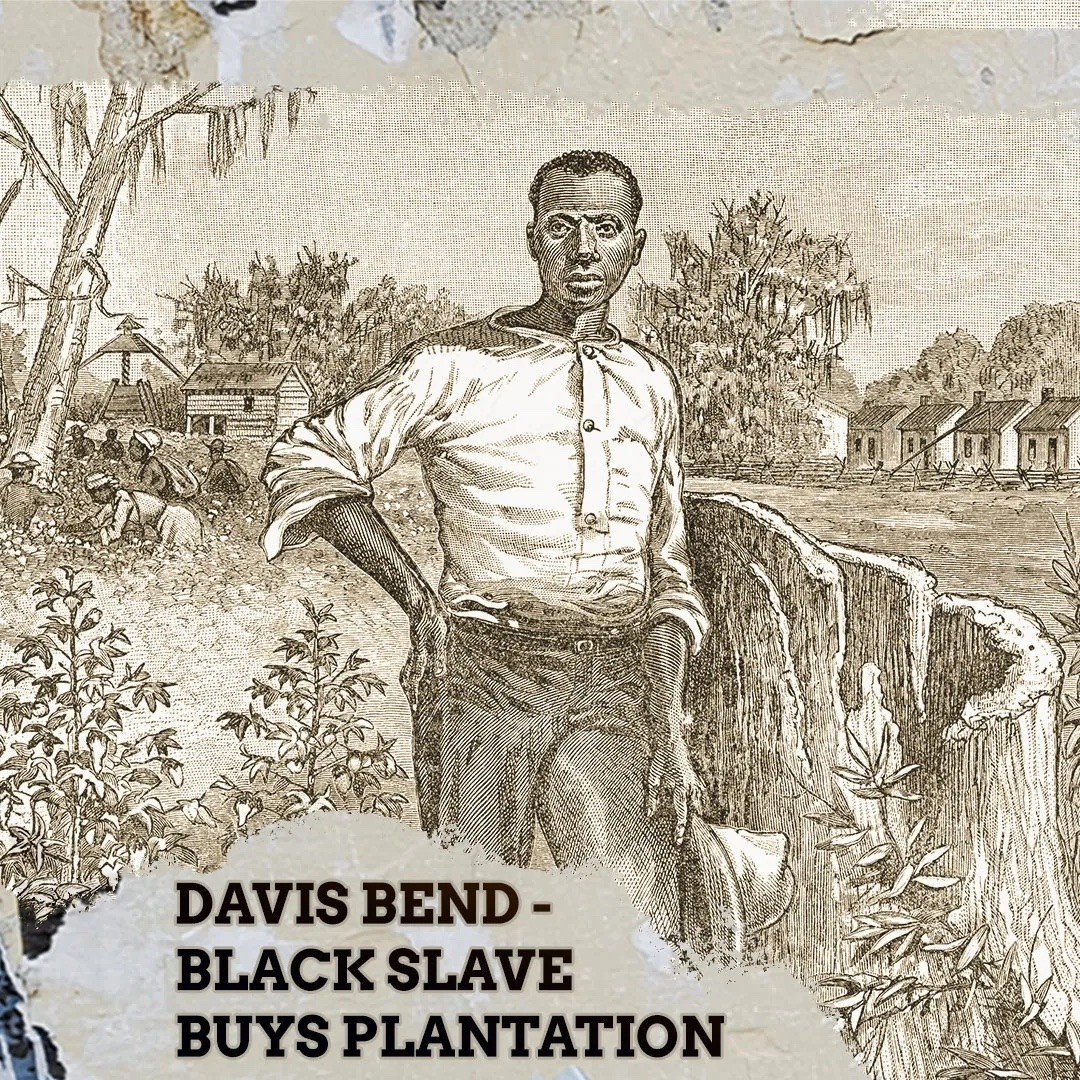
Benjamin Montgomery was purchased by Joseph Emory Davis at the Natchez market in 1836. Joseph Davis was the older brother of future Confederate president Jefferson Davis. The Davis family owned several plantations in Mississippi, including the Brierfield plantation and the Hurricane plantation in Davis Bend. Joe Davis took a different approach to manage his slaves than most other plantation owners in the deep south.
Davis didn’t believe in punishing his slaves with violence and mistreatment. Instead, he developed a system of self-government for his slave community. No slave living on the plantation in Davis Bend could be punished without being tried and convicted by a jury of his peers. If a slave happened to be convicted by his or her peers, Davis was usually very lenient when it came to handing down punishments. He also made sure his slaves live better than most in the antebellum south. Slave cabins were well-built, food was rarely rationed, and slaves were left to govern themselves. But don’t be confused, it was still slavery. Joesph Davis owned more than 300 slaves and never once freed any of them. No matter the conditions, people did not want to be owned by other people.
Ben Montgomery was originally from Virginia, which at the time was mostly a city environment compared to Mississippi’s isolated woodlands. When he first arrived at the Hurricane Plantation at Davis Bend he tried to run away seeking freedom, but was tracked down and returned to his owner. In 1793, congress passed the first-ever Fugitive Slave Act, which allowed local governments to seize and return escapees to their owners. It also imposed penalties on anyone who helped slaves hide or escape.
When Montgomery was caught and returned to Davis, he was not punished. Historians believe that instead of violence, Davis chose a diplomatic route and talked to Montgomery about why he was so unhappy. Their conversation impressed Davis and the two developed a mutual understanding that Montgomery would be allowed to flourish as a human being, as many slaves in the south were not afforded the same luxuries.
Regardless, Ben took full advantage. He learned to read and had access to the plantation library. Eventually, he began working as an office clerk for Davis, who was also an attorney. Montgomery wrote letters as well as legal briefs for his owner. He also learned land surveying and construction plans, designing special levees that protected the plantation during floods–they are still holding to this day. But Montgomery didn’t stop there. He was also the architect of several plantation buildings including the garden cottage, which became the Hurricane plantation library.
Montgomery was a true renaissance man–a person with many talents or areas of knowledge. Not only was he an office clerk and architect, but he also became a skilled mechanic who regularly maintained steam engines that operated the cotton gins and invented a boat propeller to improve the paddle wheels of river steamboats. His boat propeller invention was so efficient that his owner Joesph Davis tried to patent it under Montgomery’s name. U.S. law prohibited slaves from owning patents and it was ultimately denied.








Positive Vibrations
This man truly did it all. He also kept the books for his slave owner and was seen as a master accountant, buying and shipping supplies for Davis. Montgomery helped Davis become one of the wealthiest men in the south at the time. Eventually, Ben Montgomery also became a rich man and purchased his wife from Davis, making her a free woman and allowing her to be a stay-at-home mother to their four children.
By the start of the Civil War, Montgomery had built a life for himself and his family that few Blacks in the south could have ever imagined, but it was at risk. The Civil War meant Davis and his plantation could fall and be seized by the Union army. Because Montgomery’s life was tied to Davis’ he believed if the Hurricane plantation failed, so would the life he built. Davis, his family, and most of his slaves fled the plantation, but Montgomery stayed behind to protect it as best he could. Ultimately Union soldiers burned down the Hurricane mansion in 1863 after the city of Vicksburg fell to the Union army. Davis’ land was confiscated by the federal government and Montgomery and his family would flee to Ohio.
Once the war ended in 1865, Montgomery returned to the Davis plantation and reassumed his role as the leader among the now-former slaves. Davis and Montgomery would work together to get Davis’ land back from the federal government. The move would ultimately bring the two men even closer, as their respect for one another had grown tremendously.
In October 1866, Montgomery wrote Davis a letter asking if he could lease the Hurricane and Brierfield Plantations from his former slave owner, but Davis countered with a better offer. He offered to sell Montgomery his plantation holdings for three hundred thousand dollars with yearly interest. The sale made Montgomery one of (if not the richest) ex-slaves in the country at the time. His new plan was to build a community for former slaves built on honesty, industry, sobriety, and intelligence.
In September 1867, Montgomery was appointed justice of the peace for Davis Bend by Maj. Gen. E. O. C. Ord, the commander of the Fourth Military District of Mississippi and Arkansas. This appointment made him the first Black person to hold public office in Mississippi. Like many establishing Black towns after the end of the Civil War, Davis Bend struggled to grow due to the harsh realities of the environment. The Mississippi River constantly flooded, making it nearly impossible to harvest sizable crops. But the Montgomery and Sons grocery store continued to flourish and by 1873 Montgomery’s net worth was estimated at $230,000, putting him in the top 7% of the wealthiest merchants in the south.
Kommentar löschen
Diesen Kommentar wirklich löschen ?