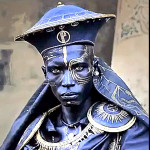
On Sept 20th we venerate Ancestor & Hoodoo Saint John Henry on the 153rd anniversary of his passing 🕊...
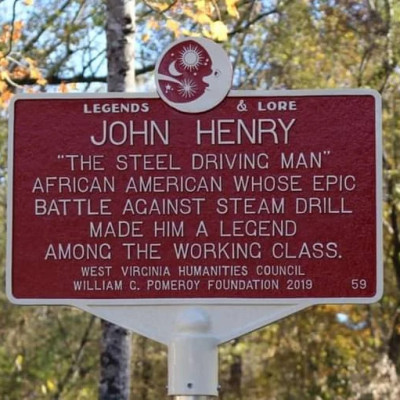
An icon of Hoodoo Folklore & History, John Henry - aka the Steel-Driving Man - embodied the otherworldly strength & will that defied physics, expectation, & the harsh conditions of his time. He is a symbol of Black Power as an unbreakable spirit of resistance and protest.
John Henry was indeed a real man behind the lore of his legend. Though there is still much debate as to who was THE John Henry among many possibilities. As it stands, most scholars believe he was born enslaved in VA in 1840’s, later emancipated after the Civil War. He stood at 6ft tall, 200lbs - a true giant of his time. He carried a beautiful baritone voice & played the banjo. That would make him the 19yr old who was convicted of theft in a VA court in 1866. For his alleged crime, he was sentenced to 10 years in the penitentiary & put to work building the C&O Railroad during the Reconstruction Era.
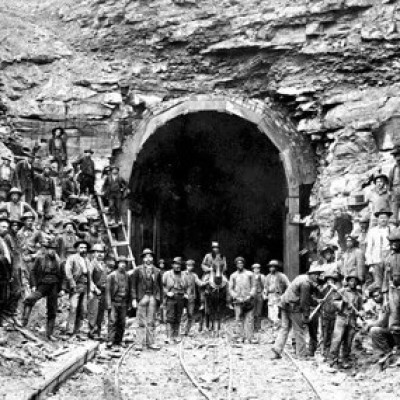
In the February 1870, the legend of John Henry was born along the C&O Railway at Big Bend Mountain near Talcott, WV - when over 1,000 railroad workers began drilling the Great Bend Tunnel where the Greenbrier River makes a seven-mile meander around the mountain. John Henry was a "free Negro" hired as a Steel-Driver on the C&O Railway. He & his counterparts were saddled with the gruesome task of hammering steel drills into rock to holes for explosives to cut a 6,450 ft-long tunnel through the mountain. Railroad work was hard; long hours of grueling labor, dangerous at times, for little money.
Holes were drilled into the layers of rock using a hand drill & hammer, then filled with powder & blasted in order to make the rock small enough to remove from the tunnel. The drill was held by a “Shaker” - tasked with turning it slightly after each blow & shake it to flip the rock dust out of the hole. The “Steel Driver” swung the hammer as hard & as often as he could, pounding the drill into the rock. John Henry was prolificly known as the strongest, fastest, & most powerful man working on the railroad.
One day, the C&O railroad company bought a steam drill. It was said that the steam drill could drill faster than any man on earth. This sparked the age-old debate & challenge of Man-versus-Machine. John Henry immediately volunteered to go up against the machine to prove that the Black worker could drill a hole through the rock farther & faster than any drill could.
John Henry wielded two 10-14lb hammers, one in each hand. He pounded the steel drill so hard & fast that he drilled a 14ft hole into the rock. The steam drill only reached 9ft. John Henry held up his hammers in triumphant victory. Nearly a thousand railroad workers shouted & cheered his name. So much so that it took them a while before realizing that John Henry was tottering. Exhausted, he crashed to the ground with his hammer at his sides. It is said that the crowd went dead silent as the foreman rushed to his side. John Henry had passed away from exhaustion due to bursted blood vessels in his brain.
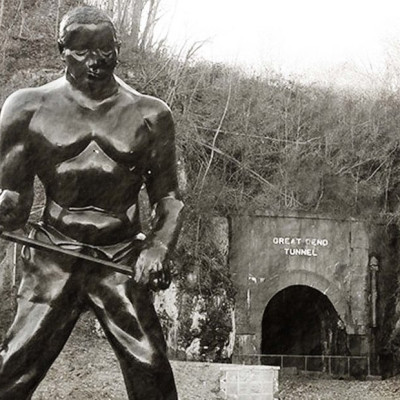
The Great Bend Tunnel was eventually completed on September 12th 1872, & remained in service until 1974. A life-sized, 750lb bronze statue of his likeness was erected on Dec 28th 1972 - on the 100th anniversary of the completion of the Great Bend Tunnel. Barbed wire was placed around the statue for many years to combat vandalism of white paint being thrown on it, gun shots to the face and torso, etc.
Sadly, no one knows where John Henry was buried. Some say his likeness can be found carved into the rock inside the Big Bend Tunnel. Others say if you walk to the darkest edge of the tunnel, you can still hear the sound of two 10-14lb hammers drilling their way to victory.
"If I can't beat this steam drill down, I'll die with this hammer in my hand!"- John Henry, as told from The Ballad of John Henry.
John Henry's choosing to go up against the steam drill was not about the challenge in and of itself. It was about proving that the body & spirit of the Black man could NOT be broken. Especially while living in such hard, grueling times. Our livelihoods were at stake & our future was even more uncertain.
Thus, he is forever immortalized in the hearts & minds of our people as symbol of the blood, sweat, & tears that drench the C&O railway by Black railroad workers of the past/present. A beacon for those who lost their lives laboring under such dangerous occupation conditions. The lore of his legend (and the lives of Black workers lost) lives on in oral tradition through story, ballads, Blue's, & work songs from coast to coast. These songs and tales did more than transform John Henry into a folk hero, they reminded us to "slow down or die", which became a tool of resistance & protest among railroad workers.
John Henry was a legend turned symbol among the Black populace of the time. And an Ancestor turned Saint for us those of Hoodoo Culture.